You can survive Spain with gestures and a smile. But if you actually want to live it, you need at least a little Spanish.
Order the wrong dish because you guessed, miss a flamenco performance because you could not read the sign, or accidentally skip tipping because you did not understand the bill.
A handful of well-chosen phrases will change everything.
The Basics You Cannot Skip
Before anything food or music specific, lock these in. They cost nothing to learn and open every door.
|
Spanish |
English |
| Hola / Buenos días | Hello / Good morning |
| Por favor / Gracias | Please / Thank you |
| De nada | You’re welcome |
| Perdón / Disculpe | Sorry / Excuse me |
| No entiendo | I don’t understand |
| ¿Hablas inglés? | Do you speak English? |
| ¿Dónde está…? | Where is…? |
One note on accents – Spain, and especially Andalucía in the south, has strong regional accents. Locals may drop the “s” from words entirely. Do not panic. Slow it down with: ¿Puedes hablar más despacio, por favor? (“Can you speak more slowly, please?”)
Spanish for Food Lovers
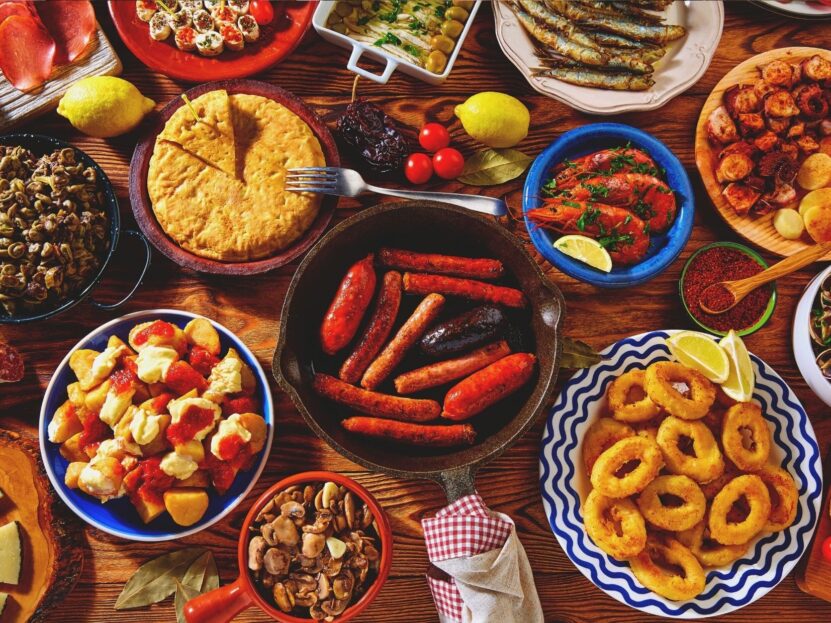
Spain’s food culture is deeply rooted in regional traditions. Knowing your way around a menu is not just convenient, it is the difference between eating well and eating whatever landed in front of you.
At the restaurant:
- Una mesa para dos, por favor – A table for two, please
- ¿Qué me recomiendas? – What do you recommend?
- Quisiera pedir… – I would like to order…
- La cuenta, por favor – The bill, please
- ¿Está incluido el servicio? – Is service included?
Dietary needs:
- Soy vegetariano/vegetariana – I am vegetarian
- Soy alérgico/a a… – I am allergic to…
- Sin gluten – Gluten free
- ¿Está picante? – Is it spicy?
Food words worth memorizing before you go:
|
Word |
Meaning |
| Tapas | Small shared dishes |
| Pinchos / Pintxos | Bread-based bites (common in the north, especially San Sebastián) |
| Ración | A larger portion, meant for sharing |
| Menú del día | Fixed-price lunch menu, usually three courses |
| Jamón | Cured ham, a staple everywhere |
| Gazpacho | Cold tomato soup, an Andalusian classic |
| Cocido | Hearty stew, essential in Madrid winters |
| Ensaimada | Spiral pastry from Mallorca |
| Pulpo gallego | Galician-style octopus with olive oil and paprika |
Translation apps help with basic menus, but professional Spanish translation services can still be useful for travelers dealing with rental agreements, event bookings, or detailed travel documents.
Spanish for Music and Flamenco Lovers

Flamenco is not background entertainment. It is an emotional, deeply rooted art form, and understanding even a few terms will make the experience land completely differently.
Useful words for live music and shows:
- ¿A qué hora empieza el espectáculo? – What time does the show start?
- Una entrada, por favor – One ticket, please
- ¿Queda alguna mesa disponible? – Is there a table still available?
- ¡Bravo! / ¡Olé! – Expressions of appreciation during a performance (Olé is the one to use at flamenco)
Key flamenco vocabulary:
| Term | Meaning |
| Cante | The singing |
| Baile | The dance |
| Toque | The guitar playing |
| Duende | The raw emotional power of a great performance |
| Tablao | A venue dedicated to flamenco performances |
| Compás | Rhythm and timing, the heartbeat of flamenco |
Sevilla, Granada, and Jerez are the traditional heartlands of flamenco. If you visit a tablao and the performer reaches duende, you will feel it. Knowing the word makes it easier to say what you witnessed.
A Few Regional Phrases That Will Earn You Smiles
Spain is not one monolithic culture. The north, south, coast, and interior each carry their own identity. Dropping a local expression or two signals genuine curiosity and earns warmth that no tourist phrase book guarantees.
- Vale – Okay, sure (used constantly across Spain)
- ¡Qué rico! – How delicious! (essential at any meal)
- Tío / Tía – Literally uncle/aunt, used casually as “mate” or “dude”
- ¡Venga! – Come on / Let’s go / Alright then (incredibly versatile)
- ¡Ojo! – Watch out / Pay attention
Conclusion
You do not need fluency. You need enough Spanish to show respect, order with confidence, and actually connect with what Spain is offering you, whether that is a plate of pulpo gallego in Galicia, a glass of jerez in Sevilla, or a flamenco performance that stops you cold.
Learn twenty phrases well, and Spain will feel like it opened a door it keeps closed for everyone who did not bother.